

/ Prof. Dr. Konrad Tiefenbacher
Folding Molecules into Shape: A Breakthrough in Macrocycle Synthesis
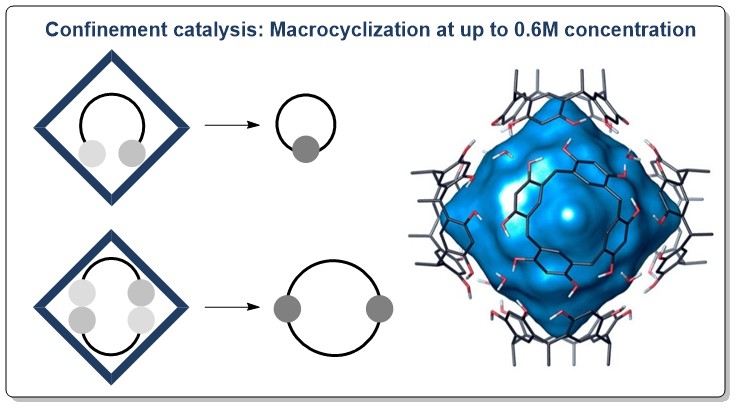
Macrocyclization reactions are traditionally performed at high dilution to prevent oligomerization or polymerization. With the use of a supramolecular capsule, this limitation can now be overcome, as the substrate reacts selectively inside the capsule to form a macrocycle or even a macrocyclic dimer, even at very high concentrations [Illustration: Konrad Tiefenbacher].
The Tiefenbacher group at the University of Basel has developed an innovative method to synthesize large ring-shaped molecules known as macrocycles. Such structures are highly valuable in modern drug discovery because they can bind selectively to complex protein surfaces.
Chemistry Inside a Tiny Capsule
At the heart of this method is a self-assembled supramolecular capsule that acts like a tiny reaction vessel. Inside this confined space, flexible linear molecules are forced into a folded conformation that brings their reactive ends into proximity, promoting efficient ring formation. At the same time, the capsule walls shield the reaction from unwanted side reactions such as polymerization.
More Efficiency, Less Waste
Traditionally, synthesizing macrocycles requires extremely dilute conditions, leading to high solvent use and waste. This new confinement strategy overcomes that limitation, allowing reactions to proceed at concentrations up to 0.6 M, more than 60 times higher than conventional methods. The result is a significant improvement in efficiency and sustainability.
Precision and Control at the Molecular Level
The researchers also achieved exceptional control over the reaction outcome. By simply adjusting the solvent, they could selectively produce dimeric macrocycles, structures that are typically very challenging to obtain. Additionally, the capsule ensures that chemical bonds form with the correct three-dimensional arrangement, a critical factor for biological activity.
Expanding the Boundaries of Chemical Synthesis
This work demonstrates how molecular confinement can push the boundaries of chemical synthesis and pave the way for more efficient access to complex molecules potentially relevant to pharmaceutical research
Original Publication:
Sudip Guria, Julia Bechter, Alessandro Prescimone, Konrad Tiefenbacher*
Confinement Catalysis Enables Macrocyclization at Up to 0.6 M: Selective Formation of Mono- and Dimeric Glycosidic Macrocycles
J. Am. Chem. Soc., 2026, doi: 10.1021/jacs.6c03730
Further Information:
Research | Synthesis of Functional Modules
Website research group Prof. Konrad Tiefenbacher
Quick Links