

/ Muhammed Jibin Parammal
From mechanism to mastery: a new blueprint for metal oxo cluster synthesis
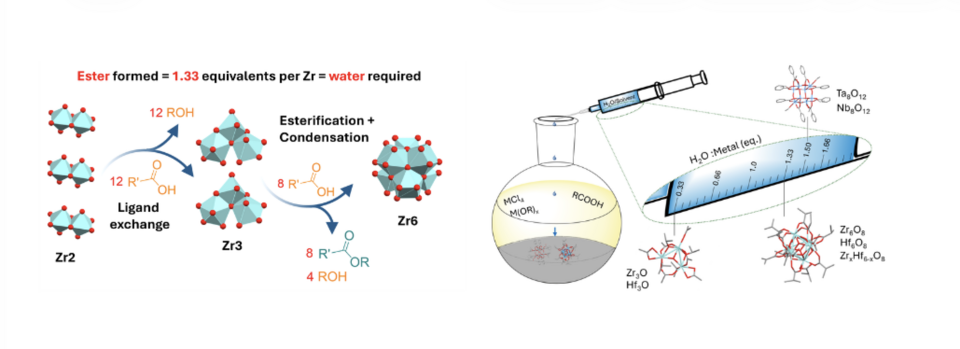
Left: A schematic representation of the non-aqueous formation mechanism of Zr and Hf oxo clusters, showing the evolution from a dimeric Zr precursor to hexanuclear Zr oxo cluster through trinuclear intermediates. Right: A schematic illustration of the "precision hydrolysis" method, demonstrating how precise, stoichiometric addition of water results in the formation of specific metal oxo architectures.
Researchers from the Department of Chemistry at the University of Basel have published two sister papers that unravel the formation of Zr and Hf metal oxo clusters and use these insights to revolutionize their synthesis. By moving from trial-and-error to precision hydrolysis, the team has developed a faster, greener, and more rational way to build these molecular building blocks for advanced materials.
1. Identifying the mechanism of Zr and Hf metal oxo cluster formation
In the first study, published in ACS Nano, the research group led by Prof. Jonathan De Roo set out to solve a long-standing mystery: how do metal oxo clusters form? These clusters - useful for wide range of applications from 3D-printing to catalysis - have traditionally been synthesized using a trial-and-error approach, often requiring high temperatures and long reaction times without a clear understanding of the underlying steps.
By combining advanced characterization techniques with detailed kinetic modelling, the team identified a crucial intermediate: an asymmetric trinuclear complex. The researchers discovered that the process is driven by in situ esterification, which slowly releases water to bridge metal atoms together. They found that this formation occurs in two distinct stages - a rapid initial step followed by a slower condensation. By elucidating the role of reaction byproducts, this study establishes a quantitative link between chemical kinetics and the formation of atomically precise clusters, transitioning the field from empirical synthesis to rational design.
2. Precision hydrolysis – a new gold standard for synthesis
Equipped with the mechanical insights from the first study, the team published a second paper in Angewandte Chemie that turns the theory into a powerful synthetic tool. If the formation of these clusters depends on the precise delivery of water, the researchers reasoned, why not provide it directly?
The team developed a method called ‘precision hydrolysis’. By adding exactly 1.33 equivalents of water to the metal precursors, they can now synthesize hexanuclear M6O8 type zirconium and hafnium clusters at room temperature, on a gram scale and by using cheaper precursors. This method replaces the traditional trial-and-error approach with a rational, retrosynthetic design.
Beyond improving existing recipes, the researchers demonstrated the versatility of this approach by creating elusive bimetallic clusters. Notably, the team achieved high selectivity for mixed-metal Zr3Hf3 clusters; the formation of this specific composition provides direct evidence that the reaction proceeds via the trinuclear intermediates identified in their kinetic studies, which then fuse to form the final hexanuclear architecture. The technique was further expanding to group 5 metals, successfully synthesizing new niobium and tantalum oxo clusters.
Original Publications:
Asymmetric Trinuclear Intermediates in Metal Oxo Cluster Formation: Kinetic Evidence for a Two-Step Esterification Mechanism.
Wilson, H.; Van den Eynden, D.; Roshan Unniram Parambil, A.; Mullaliu, A.; Seno, C.; Pulparayil Mathew, J.; Parammal, M. J.; Pokratath, R.; Whitehead, C. B.; Parac-Vogt, T. N.; De Roo, J.*
ACS Nano, 2026, 20, 7, 6156–6166 https://doi.org/10.1021/acsnano.5c20350
Original Publications:
Mechanism-Guided Precision Hydrolysis of Early Transition Metals to Access (Mixed-Metal) Oxo Clusters
Parammal, M. J.; Pulparayil Mathew, J.; Prescimone, A.; Unniram Parambil, A. R.; Wilson, H.; De Roo, J.*
Angew. Chem. Int. Ed., 2026, e25769 https://doi.org/10.1002/anie.202525769
Further information:
Website research group Prof. Jonathan De Roo
Quick Links