

/ Matteo Rutsch
Geometry Matters: Controlling Water Dynamics in Lipidic Environments
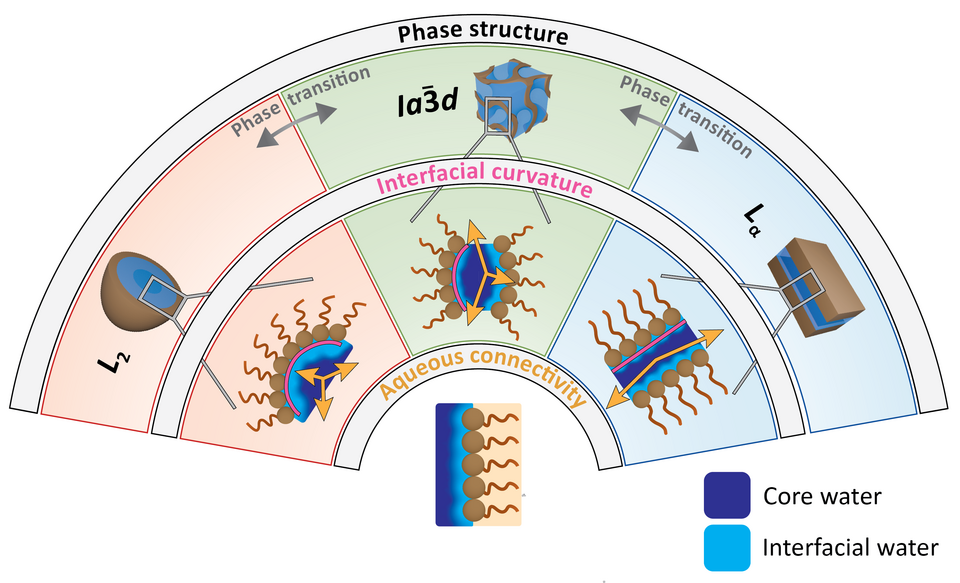
Lipidic mesophase geometry governs aqueous connectivity and interfacial curvature: The outer semicircle illustrates three key topologies: reverse micellar phase L2 (red), cubic Ia3 ̅d phase (green), and lamellar phase Lα (blue). The middle semicircle highlights the corresponding interfacial curvature (pink) and the dimensionality of the water network (orange). The inner semicircle highlights dynamically different core and interfacial water (dark/light blue). The figure was taken from from the original publication.
Water behaves fundamentally differently in biological environments than in bulk. Inside cells, for instance, water is confined in crowded settings where it is strongly coupled to surrounding interfaces. In their latest study, researchers from the group of Prof. Yang Yao used lipidic mesophases as a model membrane system to relate interfacial curvature and water connectivity to the structure and dynamics of confined water.
Lipidic mesophases: tunable model systems for confined water studies
In biological systems, water rarely exists as a homogeneous bulk liquid. Instead, water is often confined within crowded environments and continuously interacts with nearby interfaces, which drive its structure and dynamics. In their recent work, Prof. Yang Yao and her team established a direct link between the confining geometry of lipidic mesophases (LMPs) and the behavior of water, thereby extending the influence of the environment beyond mere confinement size. LMPs are self-assembled lipid nanostructures formed by mixing lipids with water. By tuning hydration and temperature, the researchers exerted control over the topology in these systems, which allowed them to progress from planar to curved and finally disconnected geometries, as illustrated in the above figure.
How geometry reshapes confined water behavior
In the lamellar phase Lα, tightly packed lipid chains form planar interfaces that promote strong lipid-water hydrogen bonding, resulting in two distinct water populations: slow, interfacial water located near the lipid interface, and faster, more bulk-like core water residing at the center of the aqueous domains.
Upon transition to the cubic phase Iad, lipid chains become more flexible while the interface bends towards the water, reducing the specific interfacial area per lipid and disrupting hydrogen-bonding, which weakens the interaction between the lipids and water. Meanwhile, the formation of 3D-connected water channels enhances long-range charge transport.
In the reverse micellar phase L2, lipid bilayers break up and aqueous connectivity is lost. Despite high lipid mobility, charge transport slows down due to isolated water domains, while strong interfacial curvature causes interfacial and core water dynamics to converge, reflecting a highly disordered hydrogen-bond network.
From confining geometry to advanced materials design
Together, these results establish a clear geometric principle: interfacial curvature and aqueous connectivity jointly control the packing of lipids, hydrogen bonding, the dynamics of confined water, and charge transport in lipidic materials. With this framework, the team around Prof. Yang Yao provides a conceptual toolbox for designing lipid-based systems in which confined water mediates key processes such as molecular transport and enzyme activity.
Original publication
Sara Catalini, Matteo Rutsch, Andrea Lapini, Barbara Rossi, Mariangela Di Donato, Brenda Bracco, Marco Paolantoni, Yang Yao
Geometry Controls Confined Water Dynamics in Lipidic Mesophases
Angew. Chem. Int. Ed. 2026, e22757, https://doi.org/10.1002/anie.202522757
Further Information
Website research group Prof. Yang Yao
Quick Links